If you're planning a large home improvement project, such as a loft conversion, extension or major renovation, one of the challenges can be deciding how to fund costs that arise at different stages of the work.
A Home Equity Line of Credit (HELOC) is one potential option. It is a flexible line of credit secured against your home. You are approved for a credit limit and can draw funds, subject to the product terms, as costs arise.
Interest is generally charged on the amount you have drawn rather than the full available credit limit. This can make a HELOC suitable for consideration where project costs are spread over several stages rather than being payable all at once.
However, a HELOC is secured against your property and may not be appropriate for everyone.
Your home may be repossessed if you do not keep up repayments on a mortgage or any other debt secured on it.
What's a HELOC, and why might it be considered for a large renovation project?
A HELOC is a flexible form of borrowing that allows eligible homeowners to access credit secured against their property.
You are given an agreed credit limit and can draw from that available amount when required, subject to the lender's terms and conditions.
Unlike a lump-sum loan, where the full amount is advanced at the outset, a HELOC allows you to draw funds over time.
That can be useful for home improvement projects because costs often arise at different stages. For example, you may need to pay a deposit first, followed by builder invoices, materials and other costs as work progresses.
With Selina’s HELOC, interest is charged on the amount you have drawn rather than the full available credit limit.
This does not necessarily mean a HELOC will be cheaper overall than another form of borrowing. The total cost will depend on factors including the interest rate, how much you draw, how long you borrow for, any applicable fees and whether rates change.
If you're new to HELOCs, our guide to what a HELOC is explains the basics in more detail.
Why staged financing can work with staged home improvements
Large renovation projects often involve a series of payments rather than one single upfront cost.
For example, payments might be required for:
- deposits;
- structural work;
- materials;
- builder stage payments;
- fixtures and fittings; and
- unexpected additional work.
A lump-sum loan provides the full borrowing amount at the start. Interest will generally be charged in accordance with the terms of that loan from the point the funds are advanced.
A HELOC works differently because you can draw from your available credit as required.
This means the amount you owe can increase as you fund different stages of the project, rather than receiving the entire amount at the outset.
Whether this results in a lower overall borrowing cost will depend on how you use the facility, the applicable interest rate, fees and how long balances remain outstanding.
How the flexible drawdown period works: draw, repay and redraw
Selina's HELOC includes a flexible period during which eligible customers can draw funds from their available credit limit and may be able to repay and redraw amounts, subject to the applicable product terms and available credit.
The flexible period and subsequent repayment period will depend on the terms of the product offered to you.
For example, suppose you are approved for a £60,000 credit limit and initially draw £15,000 for structural work.
Interest would generally be charged on the £15,000 outstanding balance rather than on the full £60,000 credit limit, subject to the product terms and any applicable fees or charges.
If you later repay part of the outstanding balance during the flexible period, this may reduce the balance on which interest is charged.
Depending on the product terms and your available credit, amounts repaid may also become available to draw again.
This flexibility can help borrowing follow the timing of project costs, but it is important to remember that redrawing increases your outstanding balance again and may increase the amount of interest you pay.
Our guide to how a HELOC works explains the process in more detail.
A HELOC can sit alongside an existing first mortgage rather than requiring you to refinance that mortgage.
However, it creates additional borrowing secured against your property, so you should consider the combined cost and affordability of both commitments.
Using a HELOC across the phases of a large project
An example can help illustrate how staged borrowing might work.
Imagine an eligible homeowner is approved for a £70,000 HELOC limit for a two-storey extension.
They might initially draw £12,000 to pay for groundwork and foundations.
Later, they might draw a further £25,000 for structural work and builder stage payments.
Their outstanding balance would then be £37,000, assuming no repayments had been made in the meantime.
If they subsequently repay £8,000 during the flexible period, the outstanding balance would fall to £29,000.
Subject to available credit, some or all of that amount may later be available to draw again for another stage of the project, as long as it’s within the flexible period, which is 2-5 years for a Selina HELOC.
This example is illustrative only. Actual borrowing limits, interest rates, repayments and total costs will depend on individual circumstances and the product offered.
The key feature is that borrowing can be drawn over time rather than necessarily being advanced as one lump sum.
HELOC drawdown vs a lump-sum secured loan for home improvements
Both a HELOC and a lump-sum secured loan involve borrowing secured against your home.
The main difference is how the funds are advanced and repaid.
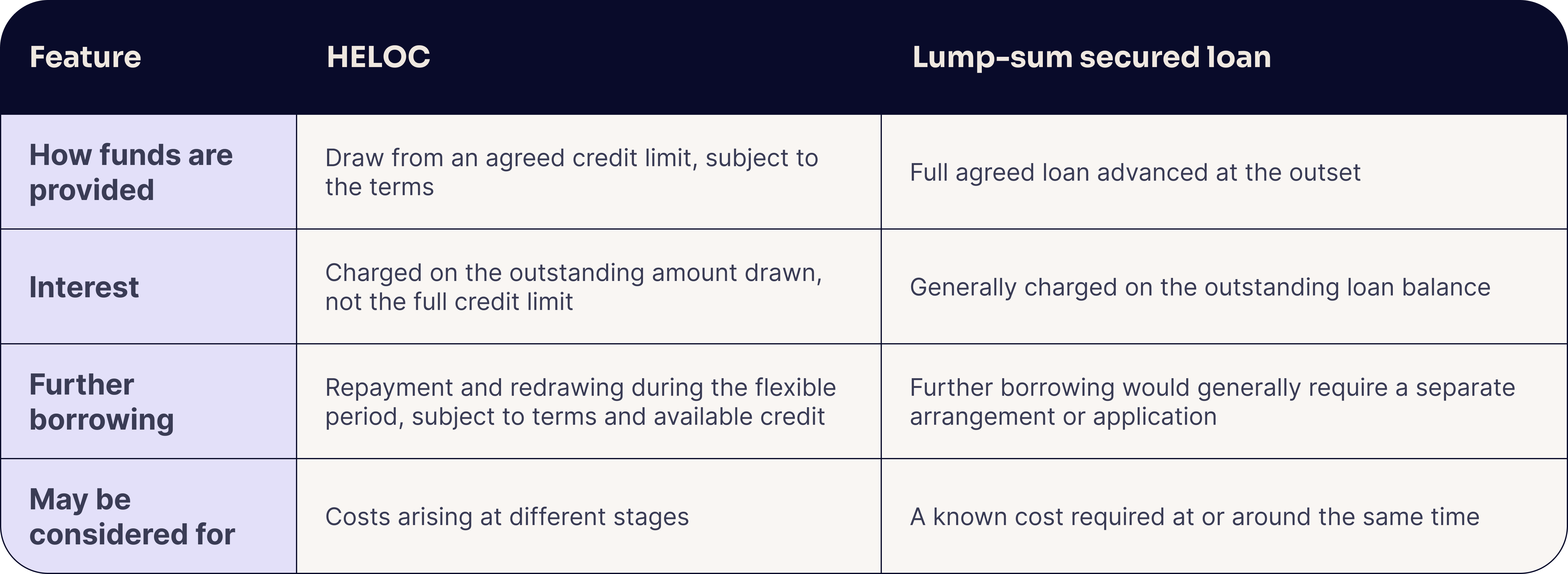
Neither option is automatically better or cheaper.
A lump-sum loan may be appropriate where the amount required is known and needed at the outset.
A HELOC may be worth considering where costs arise over time and flexibility is important.
However, the total cost, interest rate, repayment period, fees and risk of securing borrowing against your home should all be compared before deciding.
You can read more in our guide comparing a Homeowner Loan and a HELOC.
Budgeting and repaying your HELOC through a renovation
Before borrowing for home improvements, start by establishing as realistic a project budget as possible.
Detailed builder quotes can help you understand expected costs, and you may also wish to allow for unforeseen expenditure where appropriate.
Avoid borrowing more than you reasonably expect to need simply because a larger credit limit may be available.
Because interest is generally charged on the outstanding amount drawn, drawing funds only when they are required may help limit the balance on which interest is charged.
However, you should consider affordability across the entire borrowing period, not just during the renovation itself.
In particular, think about:
- the amount you expect to draw;
- the interest rate;
- whether the interest rate can change;
- any fees and charges;
- your expected repayments;
- the total amount you may repay;
- your other financial commitments; and
- whether you could continue making repayments if your circumstances changed.
A HELOC is secured against your home, so the consequences of failing to maintain repayments can be serious.
Whether it is appropriate will depend on your individual circumstances and ability to afford the borrowing.
Considering a Selina HELOC for your project?
If your home improvement project involves costs arising over several months, a Selina HELOC may be one secured borrowing option to consider.
It allows eligible homeowners to draw from an agreed credit limit over time, subject to the applicable product terms.
Before proceeding, compare the HELOC with other available ways of funding the project and consider:
- the interest rate;
- whether the rate is fixed or variable;
- fees and charges;
- how much you expect to draw;
- the borrowing term;
- your monthly repayments;
- the total amount repayable; and
- the consequences of securing additional borrowing against your home.
👉 You can review the Selina HELOC page for information about the product, eligibility requirements and applicable terms.
📖 You can also read our guide to ways a HELOC can be used.
Your home may be repossessed if you do not keep up repayments on a mortgage or any other debt secured on it.
Frequently Asked Questions
When might a HELOC not be the right fit for a home improvement project?
A HELOC will not be appropriate for everyone.
It is secured against your home, so your property may be repossessed if you do not keep up repayments.
Depending on the product, interest rates may also change, which could increase the cost of borrowing and your repayments.
If your income is uncertain, your budget is already stretched, or you could fund the project through a more appropriate alternative, a HELOC may not be suitable.
Consider your ability to afford the borrowing across the full term and compare the costs and risks of alternative options before proceeding.
Are HELOCs available in the UK?
Yes, HELOC products are available to some UK homeowners.
Availability, eligibility criteria, rates and terms vary between providers.
Before entering into any regulated secured borrowing arrangement, check the lender's regulatory status and review the product terms carefully.
How much can I borrow with a HELOC for renovations?
The amount you may be able to borrow will depend on factors including:
- the value of your property;
- the amount already secured against it;
- your available equity;
- your income and expenditure;
- your credit profile; and
- the lender's affordability and eligibility criteria.
Having a particular amount of equity does not guarantee that you will be able to borrow a corresponding amount.
The lender will assess your circumstances before agreeing to any credit limit.
What do I need to qualify for a HELOC?
Eligibility criteria vary between lenders.
Typically, a lender will consider factors such as your property, available equity, income, expenditure, existing financial commitments and credit history.
For home improvement borrowing, additional information about the proposed work may also be required.
Meeting general eligibility criteria does not guarantee approval.
Can a HELOC be used for anything other than home improvements?
Depending on the lender's terms and any restrictions applying to the product, a HELOC may be available for purposes other than home improvements.
Before using secured borrowing for any purpose, consider whether borrowing is necessary, how much it will cost and whether you can afford the repayments throughout the term.
Because a HELOC is secured against your home, failing to maintain repayments may put your property at risk.
Your home may be repossessed if you do not keep up repayments on a mortgage or any other debt secured on it.